
Service
Chimney liners
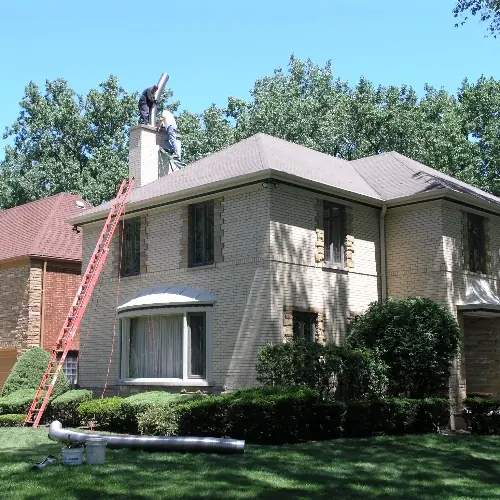
What you get: a correctly sized, sealed stainless steel flue inside your existing chimney — so heat stays out of your woodwork, moisture stays out of your walls, and the appliance finally drafts the way it should.
Twelve problems a Ventinox system solves
Relining is not decoration. Almost every chronic chimney complaint we are called out to traces back to one of these:
- Degradation of the chimney structure caused by moisture in the flue
- Water damage to interior house walls caused by porous chimney liners
- Condensation leakage through chimney thimbles and cleanout doors
- Flue condensation caused by cool chimneys
- Staining of chimney masonry due to excessive moisture in the flue
- Insufficient chimney draft caused by improperly sized flues
- Spalling and other masonry damage resulting from freeze-thaw cycles
- Improper clearance to wood framing and other combustible materials
- Cracked flue tiles caused by a chimney fire
- An unlined chimney, or an improperly constructed liner
- An inadequate number of flues within the chimney
- Downdrafting or smoking caused by unsteady draft
We strongly recommend stainless steel over aluminum
We have pulled out an aluminum liner just fourteen months after it was installed to vent an 81% efficient gas boiler. Stainless steel is suitable for wood burning, gas or oil. Aluminum is only an inexpensive alternative for certain medium-efficiency gas applications — and in Chicago it rarely lasts.
High temperature insulation is normally used with the liner, for both safety and performance.
Authorized dealer
Ventinox Authorized Dealer
We have received the Ventinox Dealer Award of Excellence annually since 1996.
Certified
Certified chimney sweeps
We employ multiple certified chimney sweeps, to the standards of the Chimney Safety Institute of America.
Diagnosis first
The flue gets sized, not guessed
An incorrectly sized liner causes creosote buildup in wood burners and carbon monoxide production with conventional fuels. We size to the appliance.
What goes wrong without a liner
When masonry chimneys were tested by the National Bureau of Standards, unlined chimneys allowed heat to move through so rapidly that adjacent woodwork caught fire in only three and a half hours. Researchers characterized building a chimney without a liner as “little less than criminal”.
The second problem is chemical. Flue gases are acidic, and if they reach the brick and mortar they literally eat away at the joints from inside the chimney. As the joints erode, heat transfers faster to nearby combustibles and gases such as carbon monoxide can leak into the living areas of the home.
The third is simple sizing. Modern wood stoves and gas or oil furnaces need a correctly sized flue to work properly — the chimney does not just take combustion products out, the draft it generates supplies combustion air to the appliance.
Unlined, cracked or wrongly sized flue?
We will inspect it — video scan included where it is needed — and quote the right lining system for the appliance it serves.