
Service
Maintenance & inspections
What you get: a chimney you can light without wondering. A certified sweep cleans the system, inspects it to the national standard and tells you plainly what — if anything — needs doing.
Chimney cleaning
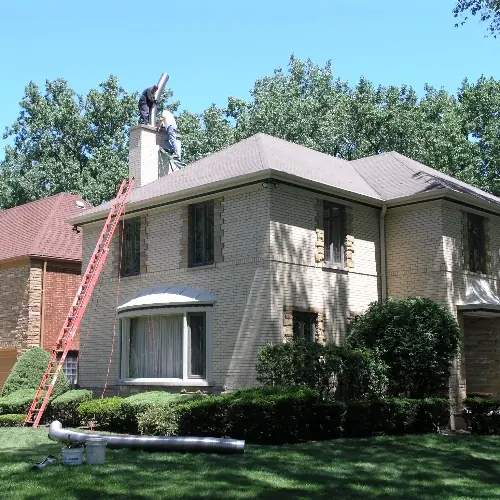
The primary job of a chimney service professional is to help prevent fires related to fireplaces, wood stoves, and gas, oil and coal heating systems — and the chimneys that serve them. Chimney sweeps install, clean and maintain these systems, evaluate their performance, prescribe changes to improve it, and educate the homeowner about safe and efficient operation.
In doing that primary job of inspecting and sweeping, chimney professionals also act as on-the-job fire prevention specialists. They are constantly on the lookout for unsafe conditions that can cause house fires or threaten residents with dangerous or unhealthy indoor air quality.
How often should I have my chimney cleaned? NFPA 211 — the national safety standard — says chimneys, fireplaces and vents shall be inspected at least once a year for soundness, freedom from deposits and correct clearances, and that cleaning, maintenance and repairs shall be done if necessary. That applies even if you barely use the chimney: animals build nests in flues, and other deterioration happens quietly.
The Chimney Safety Institute of America recommends open masonry fireplaces are cleaned at ¼″ of sooty buildup, and sooner if any glaze is present. Factory-built fireplaces should be cleaned when any appreciable buildup occurs — that is enough fuel to feed a chimney fire capable of damaging the chimney or spreading to the home.
Video scanning
A video scan uses a camera system lowered into the chimney, or pushed up from the bottom, so we can inspect the flue from a range of a few inches instead of only from the top or bottom. The image is viewed on a monitor by the inspector. Video inspections may be recommended if you or the sweep suspect specific problems, are often recommended after a chimney fire or other damage, and are a routine part of a Level II or Level III inspection.
Be aware that even the most thorough inspection will not reveal every problem. Some areas of a chimney simply are not accessible, given the construction of the house. Discuss any specific concerns with your sweep — the recommended technique is often based on your comments. It works rather like a visit to the doctor: your doctor probably doesn’t run an EKG and a full set of X-rays at every visit, but if you mention chest pains, they will run the tests related to that problem.
The three inspection levels
Chimney inspections come in many forms, and not all inspections are alike. We follow the National Fire Protection Association’s recommended inspection procedures. The NFPA divides inspection into three levels; the circumstances determine which level applies. A Level I inspection is completed during every chimney cleaning.
Level I inspection
Recommended when the chimney system is being evaluated for continued service and the conditions of use are not changing. That includes routine or annual evaluations of the venting system, replacing an appliance with a similar one, and every chimney cleaning.
A Level I inspection is limited to readily accessible portions of the venting system, the connected appliances and the chimney connection. The inspector checks the readily accessible portions of the chimney, its enclosing structure and the flue, and verifies that the flue is not blocked or significantly restricted.
Level II inspection
More detailed and thorough. Recommended when conditions of use are changing, or when a Level I inspection shows the need for a closer look. Specifically recommended when:
- An appliance is replaced with one of dissimilar type, input rating or efficiency
- Before a flue relining
- On the sale or transfer of the property
- After an event likely to have damaged the chimney, such as a chimney fire
It includes everything in a Level I inspection, plus accessible areas of attics, basements and crawlspaces; accessible areas of the chimney exterior and interior; accessible portions of the appliance and chimney connection; video scanning or other thorough inspection of the flue interior; evaluation of the flue lining to confirm its material and sizing suit the appliances served; and proper clearance to combustibles and proper construction and condition in those accessible areas. It does not require removal of permanent parts of the building, such as siding, chase covers or wall coverings.
Level III inspection
The most detailed, including concealed areas of the building — though examination of concealed areas is limited to areas reasonably suspected of containing hazards that cannot be evaluated otherwise. Because certain portions require destructive action to the building, the inspector will discuss these areas with the owner before starting.
When to have the chimney inspected
The NFPA recommends that all chimneys, fireplaces and vents are inspected annually. In addition, inspect the system:
- After any unusual or sudden event, such as a chimney fire, lightning strike or earthquake
- Before purchasing a home with an existing chimney
- Whenever changes are made to a chimney or vent system, including replacement of connected appliances
- Before major system repairs
Book this season’s sweep and inspection
One call gets the flue cleaned, the system inspected to NFPA 211, and a straight answer about what it needs next.